
Estate Vineyard

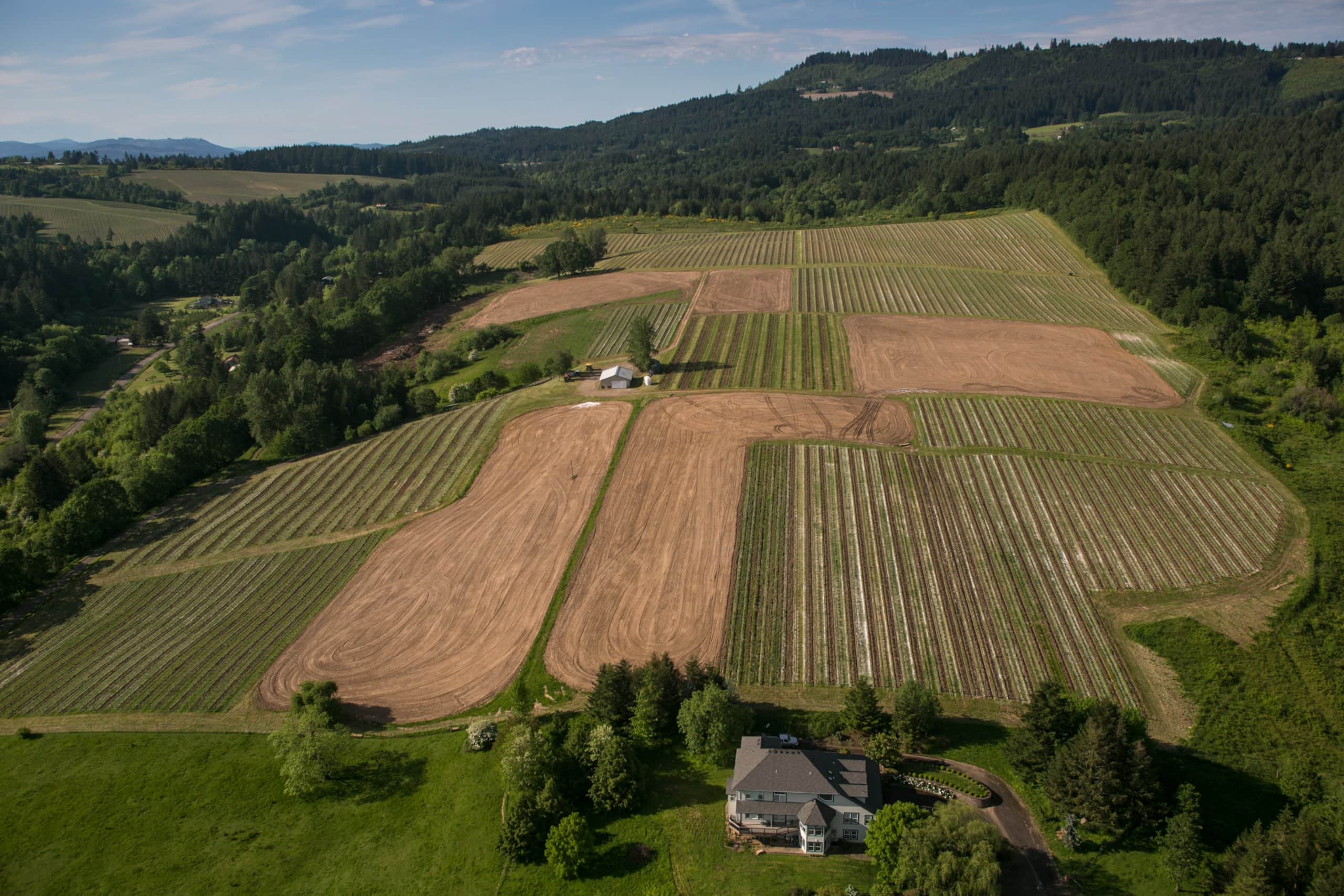
The Estate property is located in a long, narrow valley at the base of the Chehalem Hills in an appellation that is called Ribbon Ridge. The full property is roughly 52 acres in size beginning at North Valley Rd. at an elevation of 150’ and rising up to the top of our hill (and out of view of the winery) to about 425’. The initial winery was built as a 2000 square foot building back in 1986. In 1996 a 1500 square foot addition with raised ceilings and a covered crush pad was added. In 2000 we purchased the property and enclosed a 750 square foot patio on the south side of the building to serve as a barrel room and built a 1250 square foot barrel room on the north side. In 2019 a separate 2,000 square foot warehouse was constructed, which allowed us to expand to our current and maximum size of about 20,000 cases.
The vineyard itself has 3 unique qualities to it that we believe contribute to the wide-ranging nature of wines we obtain from the site.
The soil is a Marine Sedimentary soil known as Wellsford. It is a particularly sandy-talc-y type of soil that is thin, low in clay content, erosion prone and highly, highly drained. It is under-set by a seemingly endless sub-soil of sandstone which, needless to say, only further contributes to erosion, drainage and soil dryness.
The vineyard is planted directly on top of a hill and the blocks wrap around the entire face of the hillside giving us a 360 degree aspect which is unusual in Oregon to say the least.
There are multiple plantings of vines dating back to 1984 and as current as 2010 so there are sixteen (16) individual sections of Pinot Noir in the vineyard out of the 26 or so acres of Pinot Noir planted. Some blocks contain rows of alternating vine ages that are farmed, picked, fermented, barreled and bottled separately.
Winery Block: The original planting of the Estate Vineyard, and the second oldest planting in all of the Ribbon Ridge AVA, occurred in 1984. It was a 1.2 acre planting that had Pinot Noir, Chardonnay, Riesling, Muller-Thurgau and Gewurztraminer all on 12 foot spacing. Since that time the block has been grafted to 100% Pommard Pinot Noir, inter-planted in 2000 with resistant-rootstock Pommard clone to create higher density and expanded to about 1.55 acres. In 2017 and 2018 the last vestiges of the older vines were bottled on their own as a rare bottling called First Vines. Only a handful of plants now remain from the original 1984 planting.
Grapes of Wrath Block: Originally planted in 1987 as a 2.5 acre block planted to Chardonnay on the Geneva Double Curtain (GDC) trellis. Fortunately the original owners, in 1999, cut down the trellis and grafted the vines over to Pommard Pinot Noir. These rows which slope gradually to the south are the Grapes of Wrath Block. In 2000 we augmented this improvement by planting a new row of Pommard in the middle of each row to create 6 foot spacing (just like in the Winery Block) and the rows were extended to encompass all available plantable land. In the intervening years the older Pommard has been largely torn out due to phylloxera and replanted with cuttings from the block.
East and West Etzel Blocks: All in all this began as a 5 acre block planted in 1988 to self-rooted Pommard Pinot Noir. As with all the vines originally planted here prior to 1990 this block was trellised on GDC. At the beginning of 2001 we tore out every other row and the row we preserved we cut down to about 2’ in height and re-grafted Pommard Pinot Noir onto the heads which will be trellised on a traditional single wire system. In place of the one row, we planted 2 rows of Dijon 114 clone Pinot Noir so that the rows are now 8 feet apart. The Etzel Block bottling largely comes from the northern-more section (East Etzel) and is a combination of the Dijon 114 and Pommard at around a 60/40 ratio.
Bonshaw Block: A 1.5 acre that was originally palnted as Sauvignon Blanc on GDC in 1990. The shoots off of the fruiting canes were bigger than the trunks of most 3 year old plants. That gives you an idea of how vigorous GDC makes plants. We cut the trellis down and grafted this over to Pommard in 2000 and again in 2001. The block remains scattered in parts with Sauvignon Blanc plants that did not take to either grafting. This is called the Bonshaw Block and it is bottled as a single bottling.
Hallelujah Block: This south sloping 1.75 acre section of the vineyard was originall planted in 1990 to the dreaded Pinot Gris grape. We, to say the least, are not fans of this varietal. We sold the grapes until we had time to graft them to Pinot Noir in 2002. It was named the Hallelujah Block as in, “Hallelujah! It is no longer Pinot Gris!”
1990, 2002 and 2003 Sauvignon Blanc: 1.25-1.5 acres of this varietal were planted for some strange reason at this late date when most people were tearing out Sauvignon Blanc in these parts. Since then we have expanded the block with a few extra rows and lengthened the original rows in 2002 and 2003 bringing the total acreage to right around 2 acres.
Confluence and Fenceline Blocks: This is technically one 3.09 acre section of the vineyard planted altogether in 1997 to Wadensvil clone. It really is two sections as there are two types of Wadensvil planted and about 1/3rd of this east facing block slopes north and the rest slopes to the south. The south facing slope has a much thinner layer of top-soil and is the least vigorous section of the vineyard. These two sections produce very different styles of Pinot Noir. The northern section is named the Confluence Block as it is the section of the vineyard where our vineyard, Beaux Freres Vineyard and Whistling Ridge Vineyard intersect. The south slope is the Fenceline section for no other reason than it runs directly along the fence that separates our property from Whistling Ridge Vineyard.
Pheasant Block: This is a moderate to relatively steeply slope section of the vineyard that falls off to the southwest. This was planted to Pommard clone on six foot spacing in 1998. This is about 2.0 acres in size and as the name indicates there are no lack of these birds in and around this section and the scrubby area next to it.
Lakeview Block: Planted at the same time as the Pheasant Block but on a direct west slope that begins moderately and becomes steep toward the bottom of the rows. About 1.6 acres in size as well and gets its name from the ability to see our neighbor to the south’s man-made lake whose water we covet.
Ceremony Block 15A Pinot Noir: Planted in 2000, this block of Pommard clone drops to the south on a light slope. This was originally a 3.05 acre block of land adjacent to the Wadensvil block at the back of the vineyard that was planted to Pinot Noir. Named the Ceremony Block as it was the spot we picked to do a Native American ritual (led by a woman of Native American descent) to bring good energy to our new land and venture. Only the upper part of the block, at 1.1 acres, remains as Pinot Noir as the lower section has been grafted to Chardonnay.
Ceremony Block 15B Chardonnay: In 2019 the bottom 1.95 acres stretching from the highest point in the block down to a stand of trees to its east was grafted over to Dijon 76 and Dijon 96 Chardonnay. The cuttings were obtained from Brick House Vineyard.
Coury Clone Block: We planted this section to Dijon 777 in 2000 after having to tear out a section of the vineyard due to plants in ill-health and a terracing system on the short but particularly steep southern sloped hillside that was breaking down and making for dangerous tractor driving. Back when we planted this we were more enamored with “clonal diversity” than we are at this juncture. Despite the block’s favorable location within the site and the fact that it adjacent to some of the best blocks in the vineyard it rarely produced wines that made it past the Reserve bottling. In 2019 that was grafted to Coury Clone in an effort to maximize the potential of this section of the vineyard.
Last Block: This is a 1.5 acre block that was added at the bottom of the Hallelujah Block in 2001. It is Pommard clone and the name references its general picking time relative to the rest of the site. Due to being pressed up against the stand of trees and receiving very little morning sun throughout the year this block takes longer to ripen that any other part of the vineyard.
Fuego Block: We planted this in 2010 because it took us 10 years to work up the courage (and dollars) to plant this ultra-steep part of the hillside above the Winery Block. We ultimately decided to go with Pommard clone here as we felt it would best reap the benefits of the steep slope and the amazingly long time the sun stays on this particular section of the hill on long summer evenings.


Explore Our Vineyards
-

Arcus Vineyard
Arcus Vineyard This site is located in the bowl off of Worden Hill Rd. where it lies in close proximity to vineyards such as Maresh, Powell Hill, Weber, Clos Electrique, Le Pavillon and others. In our…
-

Balcombe Vineyard
Balcombe Vineyard In some ways this site is even more of a flagship vineyard for us than our Estate Vineyard. This seems counter-intuitive, however, this vineyard located about three quarters of the way up Breyman Orchard…
-
Chehalem Mountain Vineyard
Chehalem Mountain Vineyard In 1968 legendary pioneering winemaker Dick Erath moved to Oregon and established his first vineyard. Because of the long history of Erath Winery most people assume that vineyard was the one on Worden…
-

Corrine Vineyard
Corrine Vineyard Initially planted by the original owners of Rex Hill, Paul Hart and Jan Jacobsen, as Jacob-Hart Vineyard in 1987 this site sprawls across a gorgeous south facing hillside in the central part of the…
-

Durant Vineyard
Durant Vineyard Durant Vineyard is located on Breyman Orchard Rd slightly down the hill from Balcombe Vineyard. It has a southern exposure, as opposed to a western/southwestern aspect. It is located adjacent to Domaine Drouhin’s Estate…
-

Freedom Hill Vineyard
Freedom Hill Vineyard Freedom Hill Vineyard was planted by Dan and Helen Dusschee in 1982. For the past 30+ years they have lived on and farmed this historical and great Oregon vineyard. Their son Dustin works…
-

Hyland Vineyard
Hyland Vineyard Some great vineyards don’t look the part. Gentle, ordinary slopes with little visual indication of greatness can be the perfect spot for Pinot Noir. Hyland Vineyard looks the part. This isolated vineyard, somehow magically…
-

La Belle Promenade Vineyard
La Belle Promenade Vineyard Our search for vineyards is generally focused on older, historically relevant vineyards in Oregon. We have, undoubtedly, the largest broad swath of old, famous and incredibly well-farmed vineyards represented in our cellar…
-
Lia’s Vineyard
Lia’s Vineyard Lia’s Vineyard is located in the Chehalem Mountains AVA in Oregon’s Willamette Valley. The elevation ranges from 380′ to 560′ and faces primarily due south. The soils are mostly Jory, a dark reddish brown…
-

Medici Vineyard
Medici Vineyard At a time when the Dundee Hills was almost exclusively the home to the burgeoning Oregon wine industries’ initial founders, Hal Medici planted his first vines in 1976 on Bell Rd. It is located…
-

Ridgecrest Vineyard
Ridgecrest Vineyard The grandfather of all the vineyards in Ribbon Ridge. The 5-acre, 1982 block is the oldest section of vineyard in the AVA. One of the amazing and crazy things about many of these older,…
-

Weber Vineyard
Weber Vineyard Weber Vineyard was established in 1978 by Art Weber. Along with several other vineyards on Worden Hill Rd. at that time created perhaps the most striking and unique viticulture micro-climate in Northern Oregon. Weber…


