
Discover the Terroir
Our Vineyards
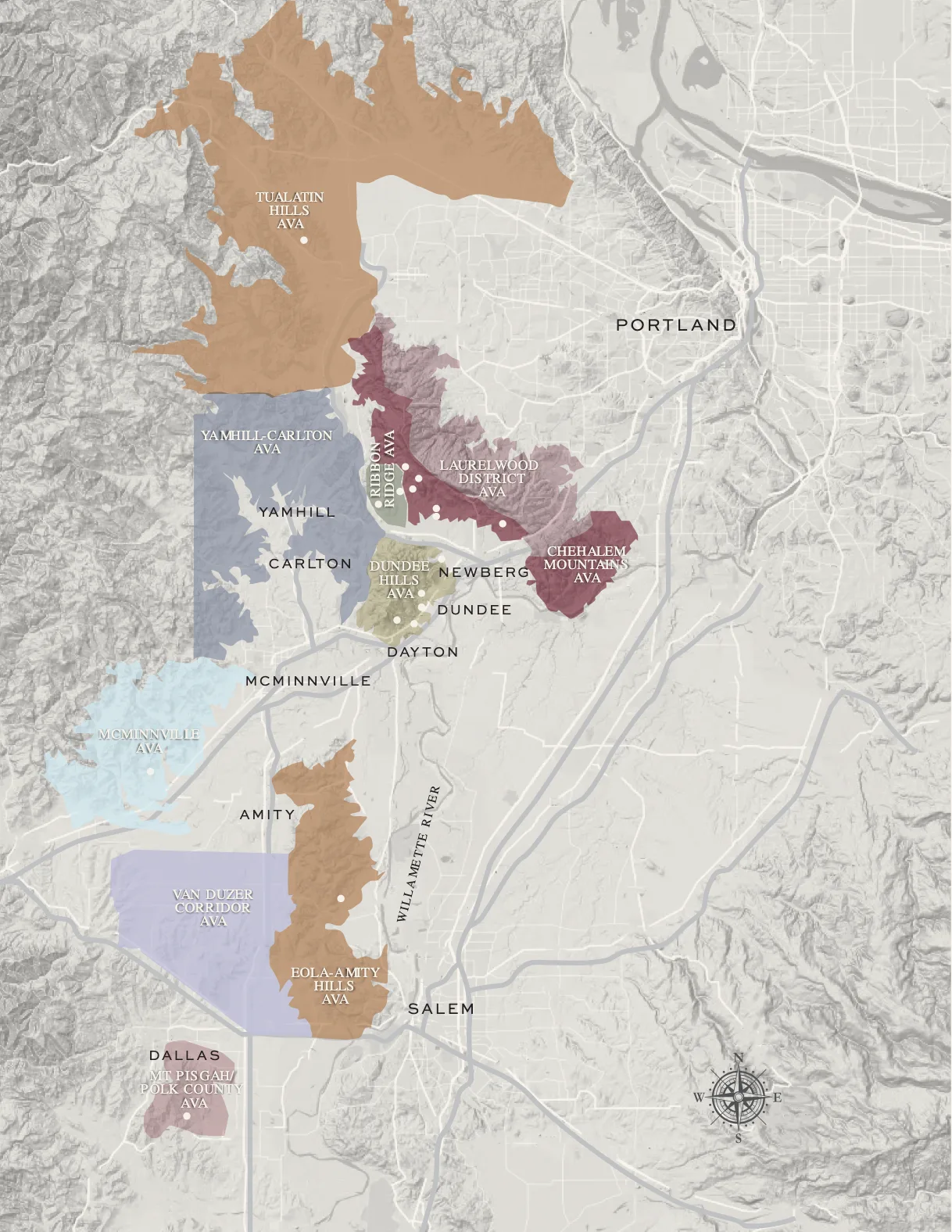
The Estate property is located in a long, narrow valley at the base of the Chehalem Hills in an appellation that is called Ribbon Ridge. The full property is roughly 52 acres in size beginning at North Valley Rd. at an elevation of 150’ and rising up to the top of our hill (and out of view of the winery) to about 425’.
Our French Oak Barrels
Cooperage
Our selection of cooperages has been assembled over 30+ years of working with a large number of barrel producers. At one point we were the second-largest customer of Tonnellerie Cadus, owned in part by Maison Louis Jadot, and that still remains the cooperage from which the vast majority of our barrels come from.
Our Estate Vineyard
Winery 2000
Original planting done in 1982, second oldest planting in Ribbon Ridge AVA.
Interplanted in 2000 to tighten spacing from 12′ rows to 6′ 6′ x 6′.
Size: 1.61 acres
Rows: 6 (6×6)
Notable Bottlings: 2017 and 2018 First Vines
Sammy’s Block
Originally planted in 1987, interplanted and enlarged in 2000.
Re-named from Grapes of Wrath to Sammy’s Block in honor of Margaret’s former boxer
Size: 2.863 acres
Rows: (6×6)
Notable Bottlings: Old Vine
West Etzel Block
Planted to Pommard in 1986, interplanted and enlarged with Dijon 114 in 2001.
Block is 80% Dijon 114
Size: 3.05 acres
Rows: (5×8)
Notable Bottlings: Old Vine, Etzel Block
East Etzel Block
Planted to Pommard in 1986, interplanted and enlarged with Dijon 114 in 2001.
Block is 80% Dijon 114
Size: 2.34 acres
Rows: 5×8
Notable Bottlings: Etzel Block
Coury Block
Originally planted in 1985. 100% of plants removed in 2000 due to incorrect terracing and farming issues.
Planted to Dijon 777 in 2000, grafted to Coury Clone in 2019
Size: 1.322 acres
Rows: (5×8)
Notable Bottlings: Coury Clone
Bonshaw Block
Planted in 1990 to Sauvignon Blanc, grafted to Pommard Clone Pinot Noir in 1998 & 1999; still has a few hundred SB plants in it.
First Oregon Pinot Noir to receive a 100-point score
Size: 0.78 acres
Rows: Multiple spacings ranging from 5′ x 8′ to 5′ x 12′.
Notable Bottlings: Bonshaw Block
Hallelujah Block:
Planted in 1990 to Pinot Gris, grafted to Pommard Clone Pinot Noir in 2002, hence the name.
Largest source of the Old Vine bottling for 20+ years.
Size: 1.708 acres
Rows: (5×8)
Notable Bottlings: Old Vine
Sauvignon Blanc
1990 planting, oldest Sauvignon Blanc vines in Oregon.
Size: 1.81 acres
Rows: (5×8)
Notable Bottlings: Estate Sauvignon Blanc, Panama White
Confluence Block-Wadensvil
Planted in 1997, nearly removed in 2000 due to mismanagement by previous owners.
Intersection of Estate Vineyard, Beaux Freres & Whistling Ridge Vineyards
Size: 3.077 acres
Rows: (4×8)
Notable Bottlings: Wadensvil Block, Old Vine
Fenceline Block-Wadensvil
Planted in 1997, nearly removed in 2000 due to mismanagement by previous owners.
Brought back nearly being dead and 15 years later began being bottled on its own.
Rows: (4×8)
Notable Bottlings: Wadensvil Block, Old Vine
Patty’s Block
Planted in 1998 to Pommard Clone Pinot Noir.
Re-named in honor of Patty in 2023 as the block became the best source of fruit in the vineyard.
Size: 1.813 acres
Rows: (5×8)
Notable Bottlings: Patty’s Block, Old Vine, Notorious
Bobcat Block
Planted in 1998 to Pommard Clone Pinot Noir.
Re-named from Pheasant Block to Cougar Block to Bobcat Block as different species made this section their home.
Size: 2.254 acres
Rows: (4×8)
Notable Bottlings: Old Vine
Chomper’s Block
Planted in 2004 to Pommard Clone Pinot Noir.
Re-named in honor of Jim’s former Corgi.
Size: 1.55 acres
Rows: 5×8
Notable Bottlings: Old Vine
Ceremony Block Pinot Noir
Planted in 2000 to Pommard Clone Pinot Noir.
Named after a Cleansing Ceremony done to welcome us to the property and wash away the negative energy of the former owners.
Size: 1.471 acres
Rows: (4×8)
Notable Bottlings: Old Vine
Ceremony Block Chardonnay
Planted to Pinot Noir in 2000; grafted to Dijon 76 and 96 Chardonnay in 2019.
Named after a Cleansing Ceremony done to welcome us to the property and wash away the negative energy of the former owners.
Size: 1.471 acres
Rows: (4×8)
Notable Bottlings: Estate Chardonnay
Fuego
Planted in 2010 to Pommard Clone Pinot Noir.
Youngest and overall steepest block on the property.
Size: 2.233 acre
Rows: (5×8)
Notable Bottlings: Estate, Reserve
Fuego
Planted in 2010 to Pommard Clone Pinot Noir.
Youngest and overall steepest block on the property.
Size: 2.233 acre
Rows: (5×8)
Notable Bottlings: Estate, Reserve
Sauvignon Blanc
2002 planting.
Size: 0.22 acre
Rows: 5×6
Notable Bottlings: Estate Sauvignon Blanc
Explore Our Vineyards
Arcus Vineyard
This site is located in the bowl off of Worden Hill Rd. where it lies in close proximity to vineyards such as Maresh, Powell Hill, Weber, Clos Electrique, Le Pavillon and others. In our first few goes with this amazing site we were getting the fruit on an inconsistent basis as we got it only twice from 2009-2015. Since 2016 we have established, apparently, a more consistent relationship here and have received the fruit each year from 2016-2019. We are fortunate to be in this situation. This is one of the great Pinot Noir vineyards in America.
The vineyard is steeply pitched vineyard and resembles a cone. The farming is impeccable. It lies on a hillside replete with some of the oldest and most noteworthy vineyards in Oregon, but beyond that it is on a hillside that is filled with people who love their vines and love this special Dundee Hills site. There is magic here for sure. In 2016 and 2017 we were getting one block, albeit the wow section: 29-year-old Pommard Clone vines on a very steep, southeast facing part of the slope planted at high-density that produce intense, wonderful fruit. In 2018 we added a couple more sections, one above and one below the block that have given us the opportunity to build in different components, make more of this wine and infuse other wines like the Volcanic and Reserve with wines made from some of the best fruit in the state.
Balcombe Vineyard
In some ways this site is even more of a flagship vineyard for us than our Estate Vineyard. This seems counter-intuitive, however, this vineyard located about three quarters of the way up Breyman Orchard Rd in the southern part of the Dundee Hills, has been maintained by Patty and Jim dating back to their work at a previous winery. Since 1997 we have managed this site and 100% of the fruit from this 7.25 acre vineyard has come to Patricia Green Cellars.
Balcombe Vineyard is owned by Mort and Joyce Cooke and was planted in 1990 exclusively to the Pommard Clone of Pinot Noir in the deep, rich Volcanic soil known as Jory. A relationship began when the Cookes contacted Patty to ask about the possibility of their vineyard being managed by the winery which Patty and Jim worked at that time. When Patricia Green Cellars was formed in 2000 the Cookes decided to follow along. Sixteen vintages later (as of the 2015 harvest) the two bottlings of Balcombe Vineyard are as well known and popular as any of the other Pinot Noir bottlingswe produce.
The vineyard is completely contiguous yet is divided into five different sections. While all five sections planted in 1990 are of the Pommard Clone and are always picked on the same day, one particular section separates itself stylistically from the other four and is thus bottled separately. Balcombe Vineyard Block 1B bottling comes entirely from the block at the lower southeast corner of the vineyard. The two bottlings share the Dundee Hills characteristics of sweetly red fruited mid-palate and sumptuous textures. The Block 1B bottling throttles things up slightly offering a darker range of fruit, more intensity across the palate and a distinctly greater tannic profile.
This vineyard is farmed organically, however the winery does not pursue any certifications at this time.
Chehalem Mountain Vineyard
In 1968 legendary pioneering winemaker Dick Erath moved to Oregon and established his first vineyard. Because of the long history of Erath Winery most people assume that vineyard was the one on Worden Hill Rd. in the Dundee Hills, but the truth is that the property that first spoke to Dick was Chehalem Mountain Vineyard on Dopp Rd. This site is literally on the borderline of the Ribbon Ridge and Chehalem Mountains appellations dividing line. Were it across the street from where it is it would be in Ribbon Ridge. The number of vineyards in the Willamette Valley prior to 1970 is limited to a handful and those with the original vines still there would be even fewer. This site carries a significance in the history of the Oregon wine industry that simply cannot be understated.
We, at this point, do not get fruit from that 1968 planting (I am going to consider that effort a work still in progress), but we get the next best thing which is the second planting which was done in 1978. This block is one of the few parts of the vineyard that rolls down to the southwest and is the lowest elevation section of the vineyard at just around 350’. The block is filled with old, gnarled vines and unfortunately not all of them are producing at maximum capacity so even in a fairly robust year this 2~ acre block of Pinot Noir is not going to produce much more than about 1 ton/acre.
At the site the block is labeled as Erath Clone. The winemaking business certainly has no shortage of myth acting as fact or facts being elusive due to the passage of time and inconsistent/non-existent/willfully incorrect record keeping. The history of Erath Clone (also known as Clone 95) has a specific history. You can read about it in great detail here http://www.princeofpinot.com/article/2033/ if you so desire. I am neither going to impugn either the current owners of Chehalem Mountain Vineyard nor implicate Dick Erath for actions that may go against the stated record of history. On one hand it is listed as Erath Clone and on the other the historical records indicate that it is not Erath Clone and therefore most likely to be Pommard. Dick was in business with Charles Coury (of Coury Clone fame) and their business was the Erath-Coury Nursery that they established in the early 70s. The Erath Clone undoubtedly hails from cuttings taken from Clos Vougeot in Burgundy in 1975-76. Is the 1978 block at Chehalem Mountain Vineyard a rogue planting of those cuttings done long before the Erath Clone was officially established nearly 25 years later? I don’t know.
The wine is different than anything else with blueberry and natural vanilla (non-barrel related) elements emerged during fermentation and have remained in the wine ever since. In a cellar where there is an immense about of a diversity despite vineyards of relatively close proximity this site and bottling absolutely stand out.
Corrine Vineyard
Initially planted by the original owners of Rex Hill, Paul Hart and Jan Jacobsen, as Jacob-Hart Vineyard in 1987 this site sprawls across a gorgeous south facing hillside in the central part of the Chehalem Mountains AVA just east of Ribbon Ridge. This hillside is unique and where Corrine Vineyard sits is a marine sedimentary soil area that, in parts, is also loaded with a quarry full of softball and greater sized basalt chunks. This is one of the warmer vineyard sites we work with and the farming there has to be very particular and precise to allow the plants to thrive in difficult growing conditions. The results of what comes from here can be spectacular. We receive several blocks at this point and are currently bottling two wines that in very different ways capture the essence of this site.
The Anklebreaker Block: This is a 2007 planting of Pommard in the single rockiest section of the vineyard. This looks not un-like many of the vineyards in Chateauneuf du Pape. The wines from this block are prodigious, dark fruited, animalistic and tannic. They are not friendly and easy. They are a pure marriage of plant and soil. Usually we shy away from sections of vineyard that are less than 15 or so years in vine age. We have so much older vine material in the winery it is hard for the younger stuff to fit in let alone compete or stand out and the inconsistent nature of younger vines and the wines they produce is usually something we are not interested in paying for. This block was so completely unique that we snatched it up when it was only in its 5th leaf. We had a feeling this could produce Pinot Noir not only unlike anything in our cellar but something distinct from basically any Pinot Noir produced in this state. In certain years (2011, 2012 and 2017) it has delivered that specialness we were seeking. This is as rare a bottling as we have and it defines the outer limits of our nature at the winery.
Wadensvil Block: This is the second oldest section remaining in the site having been planted over 25 years ago in 1991. Dead south facing on one of the gentler slopes in the vineyard, this block has been a mainstay for us since our first vintage with Corrine Vineyard in 2009. There is something about Willakenzie (marine) soil and Wadensvil clone together. They have a sympatico sort of relationship and the wines can be just thrilling examples of Oregon Pinot Noir. The wines are perfumed, red fruit oriented with hints of blacker fruit, gentle in nature but with firm enough tannins for great complexity. While we are only in our 10th vintage with Corrine Vineyard the initial bottling (2009) hints at a longevity that should easily slide past twenty years of bottle age doing the wine justice. A gorgeous and contemplative site just a few miles east of the winery.
Durant Vineyard
Durant Vineyard is located on Breyman Orchard Rd slightly down the hill from Balcombe Vineyard. It has a southern exposure, as opposed to a western/southwestern aspect. It is located adjacent to Domaine Drouhin’s Estate Vineyard. This is a historic, old Oregon vineyard, originally planted in 1973. The Durant family has owned, lived on and farmed the property for the past 40+ years. The Durants were pioneers in the Oregon viticulture world, establishing their vineyard just a few years after David Lett of Eyrie Winery and Vineyard planted his first vines only a few hundred yards away from this site.
Patricia Green Cellars’ relationship began with the Durant Vineyard in 2010. Initially, the block that was purchased was the original 1973 planting called the Bishop Block. In 2010 and 2011, only one Durant Vineyard bottling was produced. However, in 2012 a freak spring time hail storm basically stripped these vines of their flowers leaving the plants with essentially no fruit for the vintage. To compensate our production, a 2000 planting of Dijon 115 was purchased. While this was very nice fruit, it was huge, dense and dark which was quite different from the sublime and elegant bottling done the previous two vintages. So the 2012 bottling was called the Durant Vineyard, Madrone Block. Since 2013 we have bottled both expressions of the vineyard separately giving us two beautiful Pinot Noirs.
Durant Vineyard, Bishop Block Pinot Noir: The bulk of this Block remains the original planting done in 1973 by the Durant family which still owns, maintains and lives on the property. They established this site at a time when there were only a handful of vineyards in the region and were, for a time, co-founders and partners in Sokol Blosser Winery whose property they abut to the south. The wines from this block are deep, elegant, deft and have great sophistication and length to them. The thing about older vines is that the element that the age of the vine lends to the grape and, ultimately, the wine is hard to describe. At 40 years+ vine-age as in the Bishop Block there is a greater degree of subtlety to the expression of the fruit, there is a sense of minerality in the wines and the overall tone, tenor and balance of the wine is more nuanced and will evolve and survive the tests of time much more gracefully than its younger counterparts. Having access to fruit from this wonderful, old, historic family vineyard is a joy and a gift. Few wineries in Oregon that don’t already own seriously old vines like this have access to such a section of vineyard in one of the best Pinot Noir AVAs in America.
Durant Vineyard, Madrone Block Pinot Noir: The Madrone Block’s Dijon 115 planting creates a much different Pinot Noir than the Pommard Clone from the Bishop Block, and it is special enough to be bottled on its own. This block brings in the velvety texture that Dundee Hills Pinot Noirs can have without losing their sense of place. This wine is definitely deep in fruit and oozing with textural appeal. This borders right on sultry as all bottlings of this block have since we began producing it in 2012. Almost certainly, this is the single vineyard designate with the most upfront appeal to it. This will show sweet red fruits which are certainly a staple of the vintage with classic Dundee Hill sweet spices. Hard not to like.
Durant Vineyard, Chardonnay: In 2015 we revived our dormant Chardonnay program with fruit from Durant. We received Dijon Clone 95 from the upper part of the vineyard and Dijon Clone 76 from the lower part of the vineyard. Both sections were planted in the early to mid-1990s making them fully mature sections of vineyard. The Dijon 95 though is planted in the typical Jory (volcanic) soil of the Dundee Hills. However, the Dijon 76 is planted at much lower elevation down in marine sedimentary soil which is quite rare in the AVA. The combination of the two clones combined with the clearly different climate situations of the two blocks makes creating a beautiful and classic Chardonnay almost simple.
James Anderson
Co-owner/Winemaker, Patricia Green Cellars
Estate Vineyard
Freedom Hill Vineyard
Freedom Hill Vineyard was planted by Dan and Helen Dusschee in 1982. For the past 30+ years they have lived on and farmed this historical and great Oregon vineyard. Their son Dustin works with them now on the 100+ acre site. Only a handful of vineyards in Oregon could claim to have produced as many excellent wines from a wide diversity of winemakers dating back into the 1980s. Freedom Hill Vineyard would be on the very short list of great, recognized and historical vineyards in Oregon. The fact that the Dusschee family keeps working to grow better grapes on a yearly basis is a tribute to their dedication to the Oregon wine industry and the wineries they have carefully selected to work with over the years.
Freedom Hill Vineyard is the only Pinot Noir vineyard Patricia Green Cellars sources fruit from that is not in one of the smaller sub-AVAs of the Willamette Valley. It sits solely in the larger Willamette Valley AVA. While technically located in the Eola Hills, this site is just outside of the southwestern border of the Eola-Amity AVA in the town of Dallas. Historically, Freedom Hill Vineyard was known on labels like Panther Creek Cellars, Ken Wright Cellars, Bethel Heights Vineyard and St. Innocent Winery. It has a reputation for producing some of the largest scale and most structured Pinot Noirs in the valley. As phyloxera grabbed hold of the original plantings, the re-plantings and additions to the vineyard were put in on the common single-wire vertical trellis system that is most common in the Northern Willamette Valley. This has allowed for wines that still possess great intensity born from the Marine Sedimentary soil known as Bellpine. The finished wines currently flourish with tannin structure that is richer and more complex than wines from the early years.
We source fruit from close to 9 acres of Pinot Noir spread across five different sections of the site planted to Pommard Clone, Dijon 115 Clone and Coury Clone. This has allowed us a very unique approach to this vineyard. We get so much fruit that we are able to create a Freedom Hill Pinot Noir bottling that encompasses all five sections and all three clones which shows the depth, breadth, power, intensity, structure and even grace that are the natural hallmarks of the vineyard. In addition we also bottle each one of the Pinot Noir clones individually. The single clone bottlings allow us to express the differences between the three clones. In the Dijon 115 Clone, you find the savory mid-palate working with the incredible aromatics that lead to a firmly structured finish. In the Pommard Clone, the wild, gamey, explosive and dense character shines on the top of the wine. In the Coury Clone which is only grown in Oregon, there is a subtle, nuanced, violet-laden character that pulls the graceful notes forward while still having a firm backbone. All three of these wines have their own personalities even while sharing a common theme. Again, the range and beauty of the Pinot Noir’s versatility is on full display from this amazing vineyard site.
Hyland Vineyard
Some great vineyards don’t look the part. Gentle, ordinary slopes with little visual indication of greatness can be the perfect spot for Pinot Noir. Hyland Vineyard looks the part. This isolated vineyard, somehow magically established in what is still the middle of nowhere in 2018 and was even more so when initially planted in 1972, is majestic looking and the fruit delivers. Farmed biodynamically this old site is a high elevation amphitheater and cathedral. The farming in this vineyard is exquisite with particular attention to managing the soil so that the plants have an extremely healthy environ in which to grow. Vineyards tell you their story the more time you spend in them.
This site is an incredible place in this world that we are beyond privileged to source fruit from and to go to and see and hear the raptors in the trees that basically encircle the site. This place has emption born into it and the vines and wines bring that into their core. This is a special place. Our block of Coury Clone was planted in 1989. Coury Clone is a rare and unique clone of Pinot Noir brought to America from Alsace (via California) in the 1960s by Charles Coury and ultimately initially propagated at Hyland Vineyard. We have had tremendous success with this clone and likely have a more diverse selection of Coury Clone Pinot Noirs than any other winery in Oregon. The clone, elevation and volcanic soil work together to produce some of the most incredible wine we are able to make. The wine shows a brilliant balance, high-toned fruit, great acidity but also phenomenal depth and length.
La Belle Promenade Vineyard
Our search for vineyards is generally focused on older, historically relevant vineyards in Oregon. We have, undoubtedly, the largest broad swath of old, famous and incredibly well-farmed vineyards represented in our cellar than any other winery in Oregon. That determination has allowed us to create an immense amount of bottlings that have incredibly unique characteristics to each one. However, sometimes you have to spot the up-and-comer and take a chance on it in its relative youth before someone beats you to the punch and the opportunity to work with something that will be a special place passes you by. We did that with the Anklebreaker Block of Olenik (now Corrine) Vineyard back in 2010 and the results have spoken for themselves over the years.
In the spring of 2019 we grafted over close to 3.5 acres of Pinot Noir in our Estate Vineyard to either Chardonnay or another clone of Pinot so we knew that, all things being equal, we were going to be short around 10 tons of fruit just from those grafted sections. We ended up meeting and tasting with Grant Coulter who is the winemaker (and more) at Flaneur Winery and whom also was a fixture at Beaux Freres (our next-door neighbor) for years. He mentioned the possible availability of fruit from their two estate vineyard sites, one of which is La Belle Promenade. This vineyard is located on Kings Grade Rd. which is where Corrine and Lia’s Vineyard are situated, except it is further up the hill. The vineyard sits at around 800’ elevation making it the highest elevation site with which we work and…that may not be a bad idea going forward if you catch my drift.
The site was initially planted in 2012 making it the youngest site from which we get fruit. What it lacks in vine age it makes up for in location, planning and quality of farming. This is a organically farmed site is set upon a gorgeous rolling hillside that is filled with all sorts of life. In fact, the event that really sealed the deal for us was on our initial visit watching two in-flight Peregrine falcons fighting over a snake that one of them had caught. How can you pass up a site when that is your introduction to it?!? We were standing in the Ghost Barn Block (Pommard) when we saw this begin and the section of the vineyard the falcons started over is the Orchestra Block which is a massalle selection (multiple clones scattered throughout a block) planting. Those are the two blocks we ended up taking. The bottling will feature the Orchestra Block but will bring in enough of the Ghost Barn to provide a fuller-scale picture of this rare and potentially phenomenal vineyard site.
For a tremendous interactive view of this unique vineyard please visit https://www.flaneurwines.com/la-belle-promenade-vineyard/.
Lia’s Vineyard
Lia’s Vineyard is located in the Chehalem Mountains AVA in Oregon’s Willamette Valley. The elevation ranges from 380′ to 560′ and faces primarily due south. The soils are mostly Jory, a dark reddish brown silty clay loam, with a transition to marine sedimentary series around the 400′ contour. This is fairly typical in the Chehalem Mountains AVA where elevations can range from around 100′ to over 1,000′ in elevation and soil types can transition within each vineyard.
Patricia Green Cellars started sourcing fruit from Lia’s Vineyard in 2010. It took some moving around from block to block in 2011 to finally decide to produce a single vineyard bottling in 2012. Three blocks were intriguing in their own ways and allowed for the creation of a wine that was true to its place and completely unique in our cellar. These three sections were Pommard at the very top of the hill planted in 1973 in Jory soil, a section of Dijon 115 at the bottom of the site planted in Marine Sedimentary soil and a very small section of Mariafeld Clone (Clone 23). Mariafeld Clone is a rare and unusual clone of Pinot Noir that sits in the soil transition zone of Lia’s Vineyard.
Our seven other vineyards have the beauty and simplicity of being either in Volcanic or Marine Sedimentary soils. It helps to easily define a key element of their natures. We make a bottling each named after the soil type that is a “root” wine for all the wines that spring from that soil type. Lia’s Vineyard is the only vineyard we source fruit from that crosses the Marine/Volcanic transition and we intentionally pull the barrels representing each section of the vineyard to express each distinct and positive characteristics of the two soil types. The Pommard in Volcanic soil provides rich and fruit-driven aromatics along with fantastic texture. The Dijon 115 in Marine soil provides a dark-fruited mid-palate with mineral tones and excellent tannic structure. The Mariafeld in the transitional soil has so much acidity, pigment and tannin that a little goes a long way and it serves as the binding agent for the other two clones. The single vineyard bottling from Lia’s Vineyard is a fun, interesting and extremely delicious Pinot Noir that benefits from the breadth of ground it is sourced from.
Medici Vineyard
At a time when the Dundee Hills was almost exclusively the home to the burgeoning Oregon wine industries’ initial founders, Hal Medici planted his first vines in 1976 on Bell Rd. It is located due north of downtown Newberg in an area that is now part of the Chehalem Mountains AVA. Over the course of the next 25 years, the vineyard was expanded to its current size. Although the vineyard is planted to Pinot Noir, Chardonnay and Riesling, Patricia Green Cellars sources only Pinot Noir from four distinct sections.
Medici Vineyard is a good example of what you might find in the large, diverse and far-ranging Chehalem Mountains AVA. Our other two vineyards, Lia’s and Olenik, also in this AVA are largely planted in Marine Sedimentary soil. Medici begins at over 500’ in elevation and rises to close to 900’ elevation, putting it squarely in the section of hillside that consists entirely of Volcanic soil. Medici is, in fact, planted in Jory soil which gives it a flavor profile more in common with our Dundee Hills’ wines than wines from the same appellation just down the same road.
The vineyard was taken over by J. Christopher winery in 2015 and is now farmed bio-dynamically. While the vineyard lagged behind modern day style care of vineyards for a few years it is now an immaculately farmed vineyard and the quality of the fruit has certainly never been higher at any point than it is now. Few vineyards possess a better or more far-reaching view than this steep, steep site. Looking due south over Yamhill County this vineyard is like a beacon (and with a huge swath of lavender planted just above the vineyard that beacon is violet in color) over northern Newberg. A vineyard’s viewpoint does not have necessarily anything to do with a site’s inherent quality but in this case the grandeur of this vineyard is both visual and tasteful. Today this site produces wine with incredible aromatics, amazing texture and incredible length. Our blocks date back to the original 1976 of Pommard and to a 1980 planting of Chardonnay that was grafted to Dijon 777 in the late 1990s. The combination of the two makes for a truly old vines wine experience.
Ridgecrest Vineyard
The grandfather of all the vineyards in Ribbon Ridge. The 5-acre, 1982 block is the oldest section of vineyard in the AVA. One of the amazing and crazy things about many of these older, historical sites is how far out in the middle of nowhere they are. Even by today’s standards Ridgecrest is fairly isolated and back in the first decade or so of the Oregon wine industry this was beyond remote, but it worked. Located well up, nearly to the end and certainly the top of, Ribbon Ridge Rd. this vineyard sits upon dusty marine soil in the area’s most interesting AVA. Cool afternoon breezes are commonplace here allowing for long hang times and ripening that occurs in the latter part of the growing season.
We were generously offered just under ½ an acre (not being facetious about the generosity) from the oldest section of Pommard in the vineyard in 2018. This is one of if not explicitly THE benchmark vineyard in this tremendous AVA. The wine from this site is sublime, intense and completely born from a relationship that Harry Pederson-Nedry and his family began long ago that continues to this day with this beautiful piece of land that should be considered hallowed ground by those that follow wines from this region of the world. That we have any of this site at all is amazing.
We have not yet released our first wine from this vineyard. We will produce 3 barrels of this wine from the 2018 vintage. The wine shows the explosive and unrestrained nature that Ribbon Ridge can possess. This is perhaps the counter point to our First Vines block in the Estate Vineyard. This is dark and extremely concentrated with a river rock component to the finish. It is a compelling wine that should be an amazing bottle for decades to come.
Shafer Vineyard
Weber Vineyard
Weber Vineyard was established in 1978 by Art Weber. Along with several other vineyards on Worden Hill Rd. at that time created perhaps the most striking and unique viticulture micro-climate in Northern Oregon. Weber Vineyard was purchased by longtime vineyard manager Andy Humphrey in 2001. Patricia Green Cellars began sourcing fruit from the vineyard in 2005. In 2013 a portion of the vineyard was sold to a different winery along with the naming rights to the Ana Vineyard brand. While Patricia Green Cellars still sources fruit from the same sections of the vineyard since the beginning of the relationship, the wines labeled as Ana Vineyard from 2005-2012 are now called by their historical name of Weber Vineyard beginning with the 2013 vintage.
While David Lett established his original vines on Breyman Orchards Rd. in the Dundee Hills in the late 1960s and early 1970s, the upper end of Worden Hill Rd. quickly became a gathering place for people who were establishing sites that would in many ways become to the defining vineyards of the region. Art and Vivian Weber were one of those couples, originally establishing their site in 1976. This beautiful and amazing site sits on a unique geological formation on the hillside. This vineyard rolls down into a fold in the hillside that protects it in a way that mitigates the southern facing nature it has. Vineyard manager Andy Humphrey has said geologists have told him that given the way the Worden Hill Rd. hillside is shaped and the way the topography was formed it would have been extremely unlikely for the particular “bulge” that this vineyard sits upon ever would have formed.
It often feels that way in there, as if something a little cosmic is kind of going on that you can neither quantify nor truly explain particularly well without sounding a little bit, well a little bit like Andy Humphrey. That’s good. Oregon vineyards at their best have some element of oddity and mystery to them. This one has that in particular. The steep angles and the fact it is somewhat enclosed by a bowl of hills around it combined with the relatively decent elevation this makes for one of our later and sometimes latest picked vineyard each vintage. Our vines come from a 1983 planting and the fruit produces intensely Dundee Hill-styled Pinots with great red fruit character, minerality and a satin-like texture that leads into complex tannin chains making for complex wines even at relatively young ages. This is a thoughtful wine most vintages. The spiced characteristics Dundee Hill Pinots can show really let loose in this bottling and there can be a jumble of things going on here that take time to work themselves out, either as the bottle opens up for a few hours or as the wine develops its footing over years in a cellar.